
The Article Engine
When a key person walks out, the work lands on whoever's nearest it's not a staff problem, it's a process problem.
CASE STUDY

When a key person walks out, the work lands on the desk of whoever's nearest.
That's not a staffing issue, it's a process problem.
CLIENT: Digital Marketing Agency
INDUSTRY: Online Marketing Services
TEAM SIZE: Medium — multiple staff producing content across a wide portfolio of clients
BUILD TIME: From start to delivered, one week
DELIVERED: The Article Engine — Creating 60 client-focused articles a month
60 articles per month — double the agency's original requirement, built into their cap from day one.
Significantly less cost than a replacement hire —a mid-level copywriter in Australia costs $55–$75k/year, our system runs at a fraction of that
Zero key person dependency — the process lives in the system-any team member who can fill in a spreadsheet row can operate the engine.
Ops manager time freed — the person absorbing the production load was returned to the work the business actually needed them to do.
New staff onboarding in minutes, not days — the interface is familiar, training videos cover the rest.
KEY TAKEAWAYS
THE CHALLENGE
A small digital marketing agency was producing regular content for a portfolio of clients — articles, blog posts, and web copy requiring specific briefs, brand guidelines, image requirements, and calls to action.
The volume was steady. The process was not.
Then their copywriter left.
Overnight, 30 articles a month had no one to write them.
The work didn't disappear—it landed on the ops manager.
On top of their actual job: managing client accounts, coordinating the team, keeping the operation running smoothly, and now they were also writing articles. Thirty a month, for clients they didn't know as well as their former copywriter did.
The ops manager was stretched.
The content was inconsistent.
The clients were still expecting delivery.
The general managers first instinct was the obvious one: replace the copywriter.
Find a freelancer, negotiate a rate, onboard them, brief them on every client—Then hope they stay.
They were looking to pay around $30 an article—$900 a month for 30 pieces. That rate was already well below market. A competent replacement, properly briefed across a multi-client portfolio, would cost significantly more. And would quickly leave again.
Instead of continuing to struggle, they came to us.
THE REAL PROBLEM
Their copywriter leaving was only the trigger.
But it wasn't the problem.
The problem was that the agency's content production had never been a process. It was a person.
Everything that person knew—how each client liked their content structured, what tone worked for which industry, how long each piece should be, what the CTA needed to say—lived entirely in one human brain.
There was little documented workflow. No handoff protocol. No real way to onboard a replacement without weeks of knowledge transfer that would still produce inconsistent output.
When the copywriter left, they didn't take a role. They took the entire system with them.
What filled the gap was the ops manager's time—time that was already fully committed elsewhere.
But they weren't a copywriter. They were doing their best with what they knew, which meant 30 articles a month produced at a slower speed, lowered quality, at a high personal cost, and at the direct expense of the operations work the business actually needed them to do.
It's a pattern that makes a business fragile.
When the departure of one person stops a function cold, that function was never actually properly built. It was borrowed from someone's time and knowledge, and the bill eventually comes due. In this case, the bill went to the ops manager—in the form of nights and weekends writing content that was never really their job.
WHAT WE BUILT FOR THEM
The agency already used Google Sheets. So no new software was required.
No login credentials to manage. The entire control interface lives in a Sheet, and with a short training video, they could get up to speed, fast.
The team fills in the brief—client, topic, requirements, image direction, CTA—and marks the row READY.
That's the full extent of their involvement.
Within seconds, the row flips to PROCESSING and the engine handles the rest.
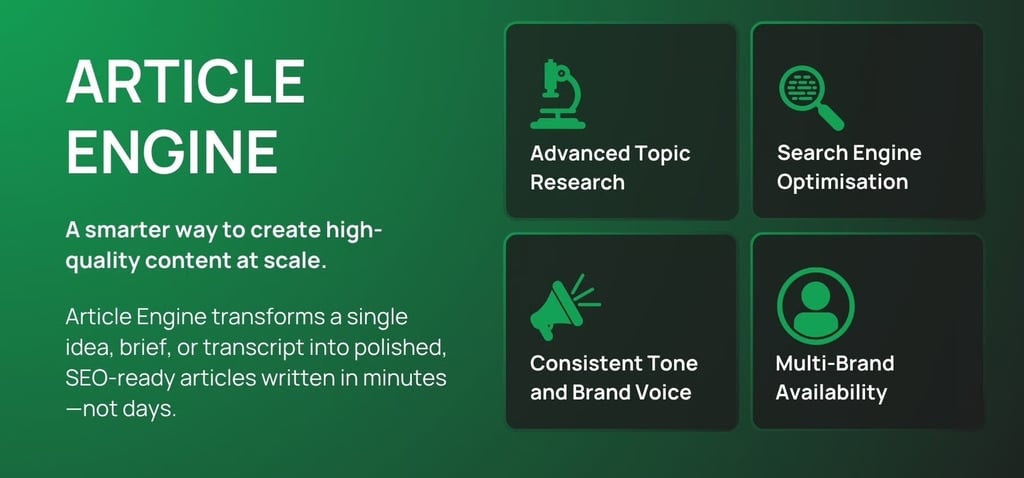
Creates a solid article outline
Writes the full article drafting to the specified length, tone.
Embeds the required SEO elements
Generates a contexually matched image
Compiles everything into a highly formatted Google Doc
Automatically shares the finished article with the relevant team members.
Because the interface is a spreadsheet, the team could queue a full month of briefs in one sitting — filling rows, marking them READY in bulk, and walking away. No waiting for one article to finish before thinking about the next.
The engine works through the queue on its own. Training of new staff takes minutes, not days.
THE RESULTS THEY SAW
The agency needed 30, well written, high-performing SEO articles each month.
But their new article engine was built to far exceed that capacity in every way. We provided them a 60-article monthly cap — double their requirement as a buffer for growth, client portfolio expansion, or peak content periods.
No additional cost. No additional headcount.
Article production time for the whole team dropped from hours per article to minutes. Only the time it takes to fill in a row in the sheet and mark it READY. Briefing, writing, sourcing images, formatting, uploading to a doc, sharing with the team—ready for final review and publishing.
All handled by the application of well-designed, smart automation.
And most importantly?
Their ops manager got their job back.
Note: This case study reflects outcomes from a real client engagement. Client name, and word marks, and logos have been kept confidential in accordance with our standard master services agreement terms and conditions.
READY TO STOP RELYING ON THE RIGHT PERSON?
Every business has a process that only works because someone specific knows how to run it. When that person leaves, you'll quickly find out how fragile it really was.
A free 45-minute Deep Dive with REGRAVITY maps the process, identifies the dependency, and shows you exactly what needs to be built.


We acknowledge the Traditional Custodians of country throughout Australia and their connections to land, sea and community; and pay respects to Elders past and present and extend that respect to all Aboriginal and Torres Strait Islander peoples today.
Get in Touch